Thank you to Sussex Life for this wonderful interview/review.
“This coming-of-age novel, which evokes classics such as The Catcher in the Rye and To Kill a Mockingbird, toes the tightrope between tragedy and comedy expertly.”
Thank you to Sussex Life for this wonderful interview/review.
“This coming-of-age novel, which evokes classics such as The Catcher in the Rye and To Kill a Mockingbird, toes the tightrope between tragedy and comedy expertly.”
Hi there.
I’m at the Belfast Book Festival tomorrow, Sunday June 12, teaching my short story class That Killer First Page. I’ll be interviewing Frankie Gaffney and Rob Doyle on Monday 13th too – two Dublin authors who’ve written explosive books on modern, urban, Irish youth.
Hope to see some of you there.
Honoured to be sharing the stage with Fiona McFarlane and Simon van Booy in my favourite venue in the world! Hope some of you can some. Here’s the skinny…
Tonight three authors will debate the pleasures and pitfalls of the two forms as readers and writers of both. Award-winning Simon van Booy joins us from the USA and Fiona McFarlane visits us from Australia, making her first UK appearance. Paul McVeigh, author and co-founder of London Short Story Festival completes the panel with literary agent Carrie Kania chairing. Lively readings, engaging conversations and signings with a glass of wine.
Simon Van Booy is the author of three collections of short stories and three novels, with his most recent novel ‘Father’s Day’, just published in the UK by One World. In 2010, he won the Frank O’Connor International Short Story Award for his collection Love Begins in Winter. His fiction has been translated into seventeen languages.
Fiona McFarlane’s novel, The Night Guest, will be published in 19 countries and 15 languages, and won a NSW Premier’s Prize and Fiona was named a Sydney Morning Herald Best Young Australian Novelist for 2014. Fiona’s short stories have been published in the New Yorker her debut collection ‘The High Places’ is out now.
Paul McVeigh’s debut novel ‘The Good Son’ was chosen as Brighton’s City Reads 2016 and has been shortlisted for numerous awards. His short stories have been published in journals and anthologies and read on BBC Radio 4 and 5. Paul is also the co-founder of the London Short Story Festival and associate director of Word Factory the UK’s premier short story salon.
£5 tickets are available in store, by telephone 020 7851 2400 or by email:piccadilly@waterstones.com
The Good Son has been longlisted for The Polari Prize – The Bookseller says it’s ‘the strongest longlist yet’.
This means my debut novel is currently a finalist in The People’s Book Prize, shortlisted for The Authors’ Club Best First Novel Award and longlisted for The Polari Prize. I’m delighted.
Have a great weekend. I might celebrate. 🙂
Are we finally entering the long overdue golden age of short fiction? Readings and a Q&A discussion about the resurgence in popularity of the short story and the challenges of the form with Joanna Walsh (Vertigo) and Carys Davies (2015 winner of the Frank O’Connor Short Story Prize for The Redemption of Galen Pike). Chaired by Paul McVeigh, author of The Good Son, co-founder of the London short story festival and associate director of The Word Factory.
Event followed by a book signing.
Suitable for age 16+
The other events I have tickets for…
– 10.30-11.30am, Cast Away/Breach: Europe’s refugee crisis, with Charlotte McDonald-Gibson, Olumide Popoola and Annie Holmes National Maritime Museum
– 14.30-15.30 Silver age of the Small Presses with And Other Stories, Galley Beggar and Salt
– 1530-16.30 Inside the Mind of an Outsider with Alex Pheby, Anakana Schoefield and Andrew Hankinson
– 16.30-17.30 The Rise and Rise of the Short Story with Joanna Walsh, Carys Davies and Paul McVeigh
– 18.00-19.00 Why we need more diverse stories with Alex Wheatle, Yvvette Edwards, Catherine Johnson and Irenosen Okojie
– 18.00-19.00 Kate Summerscale: The Wicked Boy
– 19.00-20.00 Reality Skewed with Paul Ewen and Adam Biles
– 20.00-21.00 Brix Smith Start
– 21.00-22.00ish… The Galley Beggar vs Influx with Adam Biles, Preti Taneja, Paul Stanbridge, Juliet Jacques, Courttia Newland and Irenosen Okojie

Sunday May 29 at Brighton Festival sees the closing of this year’s City Reads. Over 200 tickets already sold which blows my mind! I’ll be interviewed about The Good Son by author and journalist Laura Lockington. That it’s part of the historic 50 year anniversary of the Brighton Festival makes it all the sweeter. I hope to see some of you there – grab the few remaining tickets here.
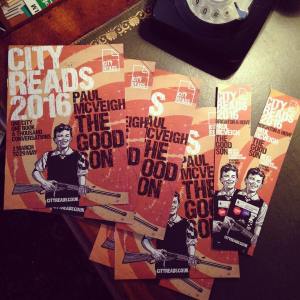
The Good Son is a finalist for The People’s Book Prize. Thank you to everyone who voted for me, I’m delighted.
Now the final stage of voting is open until July 10. Votes are carried over but you CAN vote again. I know if you’ve done it before it’s a pain but it only takes a minute if have get the chance. It would be very much appreciated. 🙂
You can vote here.

My class ‘Those Killer First Chapters: Getting the attention of agents and editors’ is back. Waterstones Piccadilly, London, July 2.
Thank you and congratulations Felicia Yap: “I attended Paul’s workshop two weeks before I went on submission. A truly enjoyable day and I learnt a lot. Sometimes, a single technical idea can make a real difference to our journeys as writers. I came away from Paul’s workshop with not one but several exciting possibilities. And yes, THE DAY AFTER YESTERDAY did get lots of attention merely two weeks later!” Selling for a 6 figure sum.
Click for more information and tickets.

So the advance copies of Guter Junge (The Good Son German translation) have arrived at the offices of Wagenbach and are about to be sent out to reviewers and booksellers.

The English and French versions of the novel came out in paperback only so this is the first hardback edition of The Good Son and the first hardback of my work – ever. It’s the little firsts that give the most excitement.

My publishers seem to be as excited as I am as they’ve put the novel on the cover of their Autumn catalogue and produced thousands of postcards to send around bookshops all over Germany. there are 3 which have different quotes from the book.

Inside, there’s a great, big spread of the brilliant photo taken by Roeloff Bakker who is also a writer. You should check him out.
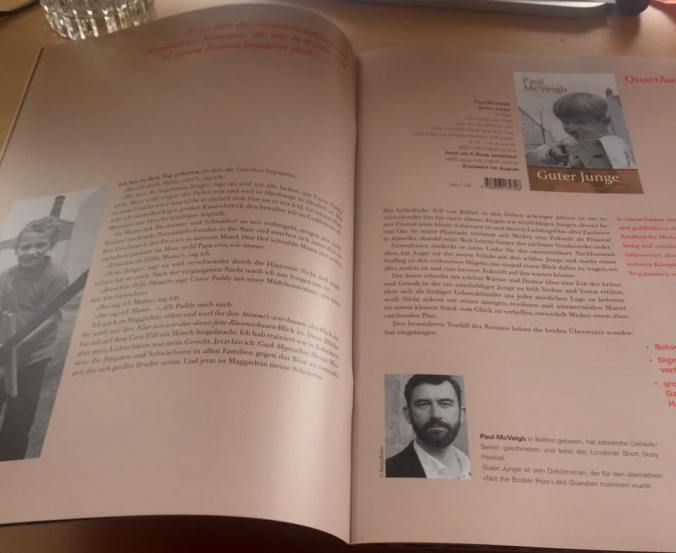
There’s also a short interview. All of this at the front of the catalogue too. I’ve been invited over to The Berlin International Literature Festival to read from the novel and I can’t wait.
More news soon…
A wonderful review of The Good Son by Cath Barton in Pank Magazine. You can read the whole thing here.
“Paul McVeigh navigates the choppy sea of Mickey’s shifting experiences and rapidly-changing emotions with skill and verisimilitude. (he) traces the physical geography of Ardoyne with as much precision as he depicts the geography of the human heart. As a reader you run up and down those streets with Mickey, onto the wastelands where kids sniff glue and bombs explode unpredictably. He navigates the tricky first person narrative style with assurance and peoples the story with vivid characters… they step off the page…
Mickey Donnelly deserves to take his place in the litany of boy literary heroes. Paul McVeigh’s prose sings from page one in the accents of the North Belfast streets, and is rich in detail. While The Good Son does not have the same breadth, it has something of the spirit of Dickens or Zola, transformed for our times. Gritty realism with a human face. Not only is it hugely enjoyable, but it also conveyed to me more of the atmosphere of the Troubles than any number of factual accounts.”


