City Reads Interview at Brighton Festival May 29

BF Logo

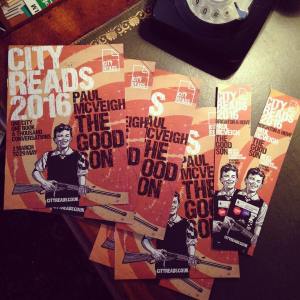
Sunday May 29 at Brighton Festival sees the closing of this year’s City Reads. Over 200 tickets already sold which blows my mind! I’ll be interviewed about The Good Son by author and journalist Laura Lockington. That it’s part of the historic 50 year anniversary of the Brighton Festival makes it all the sweeter. I hope to see some of you there – grab the few remaining tickets here.

Book Marks

My class ‘Those Killer First Chapters: Getting the attention of agents and editors’ is back. Waterstones Piccadilly, London, July 2.

My class ‘Those Killer First Chapters: Getting the attention of agents and editors’ is back. Waterstones Piccadilly, London, July 2.

Thank you and congratulations Felicia Yap: “I attended Paul’s workshop two weeks before I went on submission. A truly enjoyable day and I learnt a lot. Sometimes, a single technical idea can make a real difference to our journeys as writers. I came away from Paul’s workshop with not one but several exciting possibilities. And yes, THE DAY AFTER YESTERDAY did get lots of attention merely two weeks later!” Selling for a 6 figure sum.

Click for more information and tickets.

Guter Junge – The Good Son, Germany

German Books Arrive

So the advance copies of Guter Junge (The Good Son German translation) have arrived at the offices of Wagenbach and are about to be sent out to reviewers and booksellers.

German Book 2

The English and French versions of the novel came out in paperback only so this is the first hardback edition of The Good Son and the first hardback of my work – ever. It’s the little firsts that give the most excitement.

Wagenbach brochure

My publishers seem to be as excited as I am as they’ve put the novel on the cover of their Autumn catalogue and produced thousands of postcards to send around bookshops all over  Germany. there are 3 which have different quotes from the book.

Bochure 2

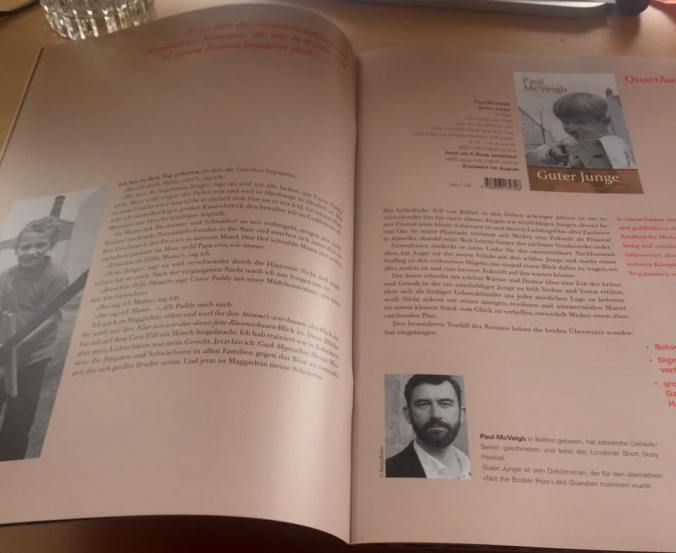
Inside, there’s a great, big spread of the brilliant photo taken by Roeloff Bakker who is also a writer. You should check him out.

Brouchure 3

There’s also a short interview. All of this at the front of the catalogue too. I’ve been invited  over to The Berlin International Literature Festival to read from the novel and I can’t wait.

More news soon…

The Good Son Review – Pank Magazine

A wonderful review of The Good Son by Cath Barton in Pank Magazine. You can read the whole thing here.

“Paul McVeigh navigates the choppy sea of Mickey’s shifting experiences and rapidly-changing emotions with skill and verisimilitude. (he) traces the physical geography of Ardoyne with as much precision as he depicts the geography of the human heart.  As a reader you run up and down those streets with Mickey, onto the wastelands where kids sniff glue and bombs explode unpredictably. He navigates the tricky first person narrative style with assurance and peoples the story with vivid characters… they step off the page…

Mickey Donnelly deserves to take his place in the litany of boy literary heroes. Paul McVeigh’s prose sings from page one in the accents of the North Belfast streets, and is rich in detail. While The Good Son does not have the same breadth, it has something of the spirit of Dickens or Zola, transformed for our times. Gritty realism with a human face. Not only is it hugely enjoyable, but it also conveyed to me more of the atmosphere of the Troubles than any number of factual accounts.”

The House That Made Me

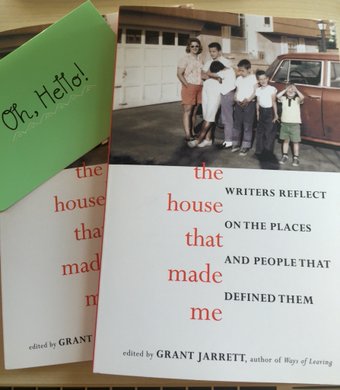
My contributors copies for The House that Made Me have arrived from Spark Press. I can’t wait to read the other essays. It’s a honour to be part of this project. My essay is called Scars. Here’s a bit about the anthology edited by Grant Jarrett.

“Home―the place where we were born, where we learned our first lessons, where family was defined. The very notion evokes powerful feelings, feelings as individual as our fingerprints, as enduring as the universe and as inescapable as gravity.

In this candid, evocative collection of essays, a diverse group of acclaimed authors reflects on the diverse homes, neighborhoods, and experiences that helped shape them―using Google Earth software to revisit the location in the process. Moving and life-affirming, this poignant anthology gives fresh insight into the concept of Home.

This anthology includes 19 essays by an array of diverse award-winning authors, including:

• Tim Johnston, author of Descent and winner of the O. Henry Prize, the New Letters Award for Writers, and the Gival Press Short Story Award

• Laura Miller, culture columnist at Slate and co-founder of Salon.com

• Porochista Khakpour, author of The Last Illusion and recipient of the 2012 National Endowment for the Arts (NEA) Literature Fellowship in Creative Writing (Prose)

• Lee Upton, author of The Tao of Humiliation, named one of “Best Books of 2014” by Kirkus Reviews

• Pamela Erens, author of the critically acclaimed novel The Virgins

• Jeffery Renard Allen, author of Song of the Shank and winner of the Ernest J. Gaines Award for Literary Excellence and the Whiting Writer’s Award”

My Interview with Garth Greenwell


This week my interview with literary sensation Garth Greenwell appeared in The Irish Times. Here’s a taster.

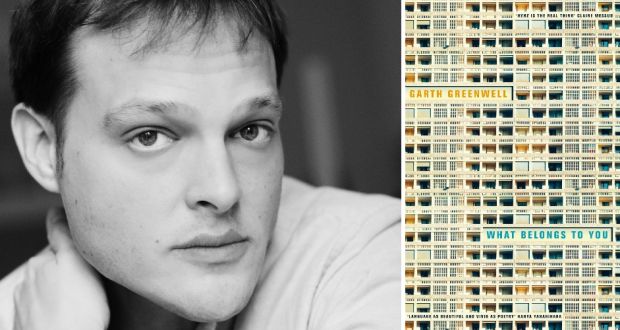
Garth Greenwell and I had connected online before he and his debut novel, What Belongs to You, crossed the Atlantic. He had read my novel and I was excited about his as it was being hailed as a masterpiece by Edmund White and every major outlet in the US seemed to have fallen under its spell. It has received the same ecstatic reception in Britain, with the Daily Telegraph calling it “an essential work of our time”. I got to meet Garth on his brief trip to the UK and on London’s South Bank we talked about writing. This is a lightly edited version of that conversation.

Garth Greenwell and I had connected online before he and his debut novel, What Belongs to You, crossed the Atlantic. He had read my novel and I was excited about his as it was being hailed as a masterpiece by Edmund White and every major outlet in the US seemed to have fallen under its spell. It has received the same ecstatic reception in Britain, with the Daily Telegraph calling it “an essential work of our time”. I got to meet Garth on his brief trip to the UK and on London’s South Bank we talked about writing. This is a lightly edited version of that conversation.

What Belongs to You started off as a novella, which won the Miami University Press Novella Prize.

Yes, it was a publication prize. There are very few places that publish novellas as standalone books. When I wrote Mitko, it was the first piece of fiction I’d ever written; before that I’d only ever written poems. When I finished it, I thought that the story was done, as it tells a complete arc. I thought it was finished but it’s what’s now the first section of What Belongs to You.

Happily, between submitting to the Miami Prize, winning and signing the contract for publication, I realised that Mitko was part of something larger, that there would be more to come, and so I was able to make sure that would be possible with Miami University Press.

Can you pinpoint the moment you realised it was meant to be a longer piece? Was it a wake-up-in-the-middle-of-the-night experience?

I think at every point in writing the book I was completely in the dark about what it was going to be. I feel like it’s a book I wrote not just sentence by sentence but really clause by clause.

After finishing Mitko I didn’t think I was going to write more prose for a while, I thought I had some poems to write. And then one day I just started hearing this very importunate and angry voice. It just took me over. I wrote the second section of the book very fast, in a white heat. And it wasn’t until I was deep into that section that I realised it was connected somehow to Mitko. Even though the character Mitko doesn’t appear anywhere in that second section, I understood that it was the same narrator and that somehow the story that voice was telling was in resonance with the story of Mitko.

You said you wrote What Belongs to You clause by clause, which is how I imagine a poet writes/thinks. Do you think being a poet has helped bring something different to your novel?


To read Garth’s answer and the rest of the interview, head over to The Irish Times.

Le Monde Reviews ‘Un bon garçon’

So it looks like Le Monde likes ‘Un bon garcon’ – that’s if google translate actually works lol…
“Paul McVeigh has written a first novel of beautiful generosity, poignant in this delicate manner in which he evokes the brutality of an era. Same (?) writing weaves around the “troubles” in Northern Ireland, the fabric of childhood and adolescence, finely restoring the path of Mickey: a striking fresco, mixing historical upheavals and hardships of a family shattered.”
Le Monde Des Livre Review

Lucy Caldwell Launch May 3

Here’s your lucky chance to come along to Lucy Caldwell’s launch of her debut short story collection Multitudes. Here’s a little more about Lucy – it’s pretty amazing.

“Lucy Caldwell is the author of three novels and several stage plays & radio dramas.

Awards include the Rooney Prize for Irish Literature, the Dylan Thomas Prize, the George Devine Award for Most Promising Playwright, the BBC Stewart Parker Award, the Susan Smith Blackburn Award, the Imison Award, a Fiction Uncovered Award and a Major Individual Artist Award from the Arts Council of Northern Ireland.

Her most recent novel, All the Beggars Riding, was chosen for Belfast’s One City One Book campaign in 2013 and shortlisted for the Kerry Group Irish Novel of the Year.

Her debut play, Leaves, premiered at Druid Theatre’s Chapel Lane and the Royal Court Upstairs in 2007. Subsequent plays include Guardians and Notes to Future Self, and she is currently working on a version of Chekhov’s Three Sisters set in 1990s Belfast.

She was shortlisted for the 2012 BBC International Short Story Award for her short story ‘Escape Routes’ and won the Commonwealth Writers’ Award (Canada & Europe) in 2014 with ‘Killing Time’.”

If love short stories and you’d like to come along write to the email on the invite.


Multitdues_invite1 [371329] [382252]