(This essay was first published in The Irish Times when my novel The Good Son was their book club choice.)
Reading What I Did on My Summer Holidays again was an unsettling experience. A peeking-through-your-fingers cringing you get looking at early work and the realisation that this was the beginning of a journey that would lead me here, a mind-boggling 17 years later. I lost this story when a hard drive got corrupted many years back, in fact, I lost the first draft of the novel at the same time. I was so disheartened I took a long break from writing and had to begin the novel again, from scratch, years later.
Being my first attempt at prose, never mind a short story, I now see the gaps and failings. I’d never even read a short story before writing one. Back then I was writing comedy shows in London, had done a little for TV and was teaching comedy sketch writing at Hampstead Theatre. After seeing one of my shows, author P-P Hartnett got in touch asking me to submit to a short story anthology he was editing. I hadn’t written prose since my essay What I Did On My Summer Holidays at school – most of this I’d invented to make me look good. So when I sat down to have a go at writing a short story I took the most common advice I’d heard – write what you know. I thought about the last time I’d written and used that title as a little wink to it. I thought of a moment in my childhood, on a visit to my Aunt’s, and used that as an intention. I had reached the word limit before I’d gotten to the lane up to my Aunt’s house – this was the moment the idea this story could become a novel first occurred to me. None of the action I’d written was autobiographical though the arena was. I edited down this chunk and added a fictionalized version of the scene I had originally intended at my Aunt’s. Most importantly, it was Mickey’s voice that came out. He’s been here ever since. Though he stays the same age and size in my head, like Bart Simpson, his personality has changed over the years. Mickey got craftier, funnier, dafter, stronger and braver with each draft of The Good Son.
The story got accepted by the editor, was published. I went on a mini-tour of Waterstones shops in the UK and Ireland. Bizarrely, I read in Waterstones Piccadilly, with whom I would later develop an important working relationship, Brighton where I would later live and The Good Son become the City Reads, Dublin where I will come discuss the book with Martin Doyle as a part of the Book Club and Belfast, where of course, the book is set. Never thought about that before – it’s like I’ve been reading one of those weird, cultish books on the power of coincidence.
Mickey is less resilient in this story than he would develop into for The Good Son. Still a thinker but of a different kind. In the novel he has progressed from see how bad it is? to things are bad but I will win. You can see in this story that although Mickey has flashes of humour, the overall tone is more sombre than in the novel and hints at darker stories underneath – for those of you who haven’t read The Good Son, the novel turns up the volume on the funny. Writing comedy for years made me want to write something dark. To swim in that part of me. I explored those darker stories in the first drafts of the novel and it was a very different book to the one that was published.
I left writing comedy not too long after this story and by the time I was doing the major re-writes about 4 years ago I had lost my need to distance myself from the comedy world and was ready to embrace it again.
I edited a huge amount of swearing out of the story for publishing here but there’s still quite a bit. The swearing wasn’t in there to shock but to address what I saw as the omission of swearing children in books. This runs closely with the absence of working class voices. I contend that Ireland has more working class writers and themes than the UK.
On the streets of Belfast, in the working class sectarian ghettoes of my day, swearing punctuated every sentence. Think of the movie portrayals of the Italian ghettoes of New York and you’re getting close. Of course, it’s related to working class culture. The obvious reason for this would be lack of education but it’s more complex and more powerful. It’s a badge of honour. We are happy as we are. Integrating swearing into everyday parlance is a literal fuck you to those who have – be that money or intelligence (really meaning education or the investment in it) or even talent. And as for those of their community who possessed any of these passports – permission to enter the world beyond, a way out – they need to be nifty with their tongue.
It’s not called a class war for nothing, and defecting is a betrayal. Swearing, harsh words, can be a tool of peer repression too, a whip to keep you in line. Perhaps a brutal environment begets a brutal language (also reflected in the harshness of our Belfast accents?) and a brutal socialisation. This is glimpsed in the story and explored in more depth in the novel. If you adapt how you speak – stop the swearing, for example, or speak softer, expand your vocabulary, use correct grammar – then you are rejecting your people, rejecting what your community stands for. You are saying the other world is better, that you aspire to have. If it is a world where excelling at harshness makes you a winner then being soft, believing in gentleness and kindness makes you a loser. You will be eaten up or mocked.
But it’s not all doom and gloom. Swearing can be fun. The playfulness I’ve seen in the use of the filthiest of words, especially when coming from the unlikeliest mouth, has created some of my best childhood memories. Playing with the power of profane leads into the role of humour in harsh environments – I know Lisa McInerney is going to talk about this and I’m looking forward to hearing what she has to say. Playing with the harshness of words can take its power away too. Jostling with your friends and family – the Northern Irish slegging is there to keep you humble and thicken your skin. Harsher than slagging, it pushes the boundaries, testing just how much mockery and criticism a person can take before cracking and it often only ends when someone breaks.
A sharp wit can give you a place in this kind of world when brawn, connections or the threat violence are not your disposal. Mickey has that. He needs it.
As I said What I Did On My Summer Holidays was first time. Be retrospectively gentle with me.
(You can read What I Did On My Summer Holidays here.)
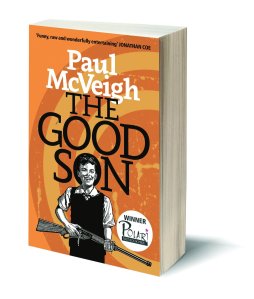
Buy Here
Winner of The Polari Prize
“Pungently funny and shot through with streaks of aching sadness.” Patrick Gale
“I devoured it in a day, but I’ve thought about it for many, many more.” Lisa McInerney
“Funny, raw and endlessly entertaining.” Johnathan Coe




 Paul McVeigh